Template
The template choice type is not meant to be a replacement for Templater plugin or core Templates. It's meant to augment them, to add more possibilities. You can use both QuickAdd format syntax in a Templater template - and both will work.
The Template choice builder groups its settings into four sections: Template (template path and file name format), Location (where the file is created), Linking (whether and how to link to the created file), and Behavior (what happens when the file already exists, and how the file is opened).
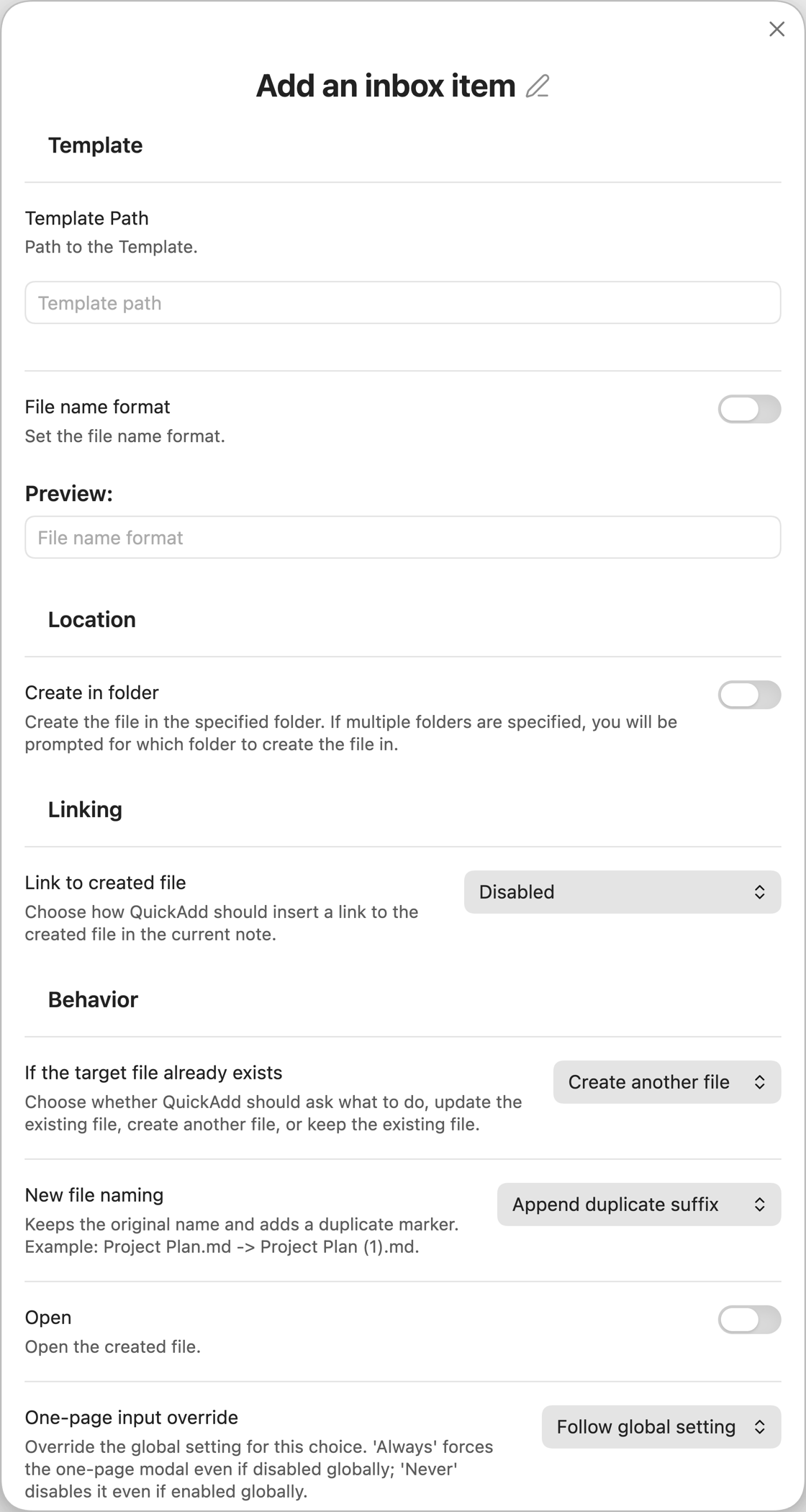
Mandatory
Template Path. This is a path to the template you wish to insert. Paths are vault-relative; a leading / is ignored.
QuickAdd supports markdown (.md), canvas (.canvas), and base (.base) templates. The created file uses the same extension as the template.
If you want a new markdown note to include a live embedded Base dashboard, see
Template: Create an MOC Note with a Link Dashboard.
Optional
File Name Format. You can specify a format for the file name, which is based on the format syntax.
Basically, this allows you to have dynamic file names. If you wrote £ {{DATE}} {{NAME}}, it would translate to a file name like £ 2021-06-12 Manually-Written-File-Name, where Manually-Written-File-Name is a value you enter when invoking the template.
If you disable File Name Format, QuickAdd uses {{VALUE}} as the file name format. This keeps the default behavior of prompting for a file name when you run the choice, with the same {{VALUE}} / {{NAME}} behavior described in the format syntax docs.
New note location. A dropdown that controls where the note is created. Pick one of four modes:
- Obsidian default – use Obsidian's "Default location for new notes" setting.
- In a specific folder – create the note in the folder(s) you configure below. If you specify one folder, the note is created there; if you specify multiple, you'll get a suggester asking which folder to use. An Include subfolders toggle (shown only in this mode) lets the suggester offer the selected folders and their subfolders. Folder paths support QuickAdd format syntax, including
{{VALUE}}, named values such as{{VALUE:client}}, dates, and global variables — for example,Projects/{{VALUE:client}}/{{DATE:YYYY}}prompts for a client and creates the file under that client's folder for the current year. - Same folder as current file – create the note next to the currently active file (falls back to the vault root if no file is open).
- Ask for folder each time – prompt you to pick any folder in the vault each time the choice runs.
Switching modes hides the fields that don't apply, but your configured folder list is kept — switching back restores it.
Link to created file. Choose how QuickAdd should insert a link to the created file in the current note. Pick one of three modes:
- Enabled (requires active file) – throw an error if no note is focused (legacy behavior)
- Enabled (skip if no active file) – insert the link when possible and skip silently otherwise
- Disabled – never append a link
When either enabled mode is selected, Link placement lets you choose where the link is placed:
- Replace selection - Replaces any selected text with the link (default)
- After selection - Preserves selected text and places the link after it
- End of line - Places the link at the end of the current line
- New line - Places the link on a new line below the cursor
Link type. Shown only when Link placement is Replace selection. Choose whether replacing the selection should insert a Link or an Embed.
If the target file already exists. Choose whether QuickAdd should ask what to do, update the existing file, create another file, or keep the existing file.
Open. Will open the created file. When enabled, additional file-opening controls appear (these are shared with the Capture choice):
- File Opening Location – where to open the file: Reuse current tab, New tab, Split pane, New window, Left sidebar, or Right sidebar.
- Split Direction – shown only when the location is Split pane. Arrange the new pane as Split right or Split down.
- View Mode – how to display the opened file: Source, Preview, Live Preview, or Default.
- Focus new pane – shown for every location except Reuse current tab. Focus the opened tab immediately after opening.
File Already Exists Behavior
When a file with the target name already exists, the setting works in two steps:
- If the target file already exists: choose one of these high-level behaviors: Ask every time, Update existing file, Create another file, or Keep existing file
- Update action: shown only when you choose Update existing file
- New file naming: shown only when you choose Create another file
Ask Every Time
QuickAdd prompts you to choose one of these actions each time the target path already exists:
- Append to bottom
- Append to top
- Overwrite file
- Increment trailing number
- Append duplicate suffix
- Do nothing
Update Existing File
These options modify the existing markdown, canvas, or base file:
- Append to bottom: Adds the template content to the end of the existing file
- Append to top: Adds the template content to the beginning of the existing file
- Overwrite file: Replaces the existing file content with the template
Create Another File
These options keep the existing file untouched and create a new file instead:
- Increment trailing number: Changes trailing digits only while preserving zero padding when present. For example,
note009.mdbecomesnote010.md. - Append duplicate suffix: Keeps the full base name and adds
(1),(2), and so on. For example,note.mdbecomesnote (1).md.
Keep Existing File
Selecting Keep existing file applies the same result as choosing Do nothing from the prompt:
- Do nothing: Leaves the existing file unchanged and opens it automatically. This does not require the separate Open setting.